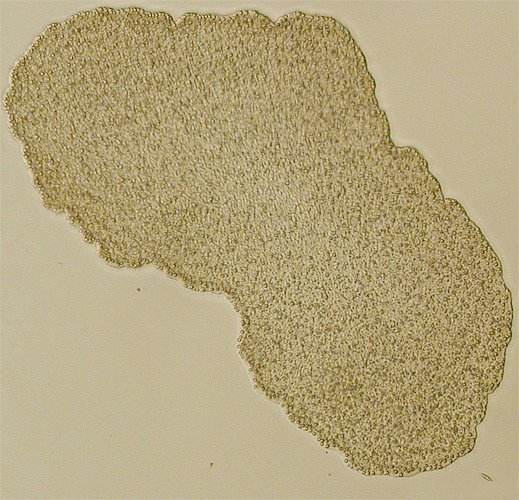
A Paris zoo is showcasing a mysterious creature dubbed the “blob,” a yellowish collection of unicellular organisms called a slime mold that looks like a fungus, but acts like an animal.
This newest exhibit of the Paris Zoological Park, which goes on public display on Saturday, has no mouth, no stomach, no eyes, yet can detect food and digest it.
The blob also has almost 720 sexes, can move without legs or wings and heals itself in two minutes if cut in half.
“The blob is a living being which belongs to one of nature’s mysteries,” said Bruno David, director of the Paris Museum of Natural History, of which the Zoological Park is part.
“It surprises us, because it has no brain but is able to learn (…) and if you merge two blobs, the one that has learned will transmit its knowledge to the other,” David said.
The blob was named after a 1958 science-fiction horror B-movie, starring a young Steve McQueen, in which an alien life form consumes everything in its path in a small Pennsylvania town.
“We know for sure it is not a plant but we don’t really [know] if it’s an animal or a fungus,” said David.
“It behaves very surprisingly for something that looks like a mushroom … it has the behaviour of an animal, it is able to learn.”
Source:
https://www.cbc.ca/news/technology/paris-zoo-blob-1.5325747